
We gave the world’s best AI video models one job. None of them could ship it.
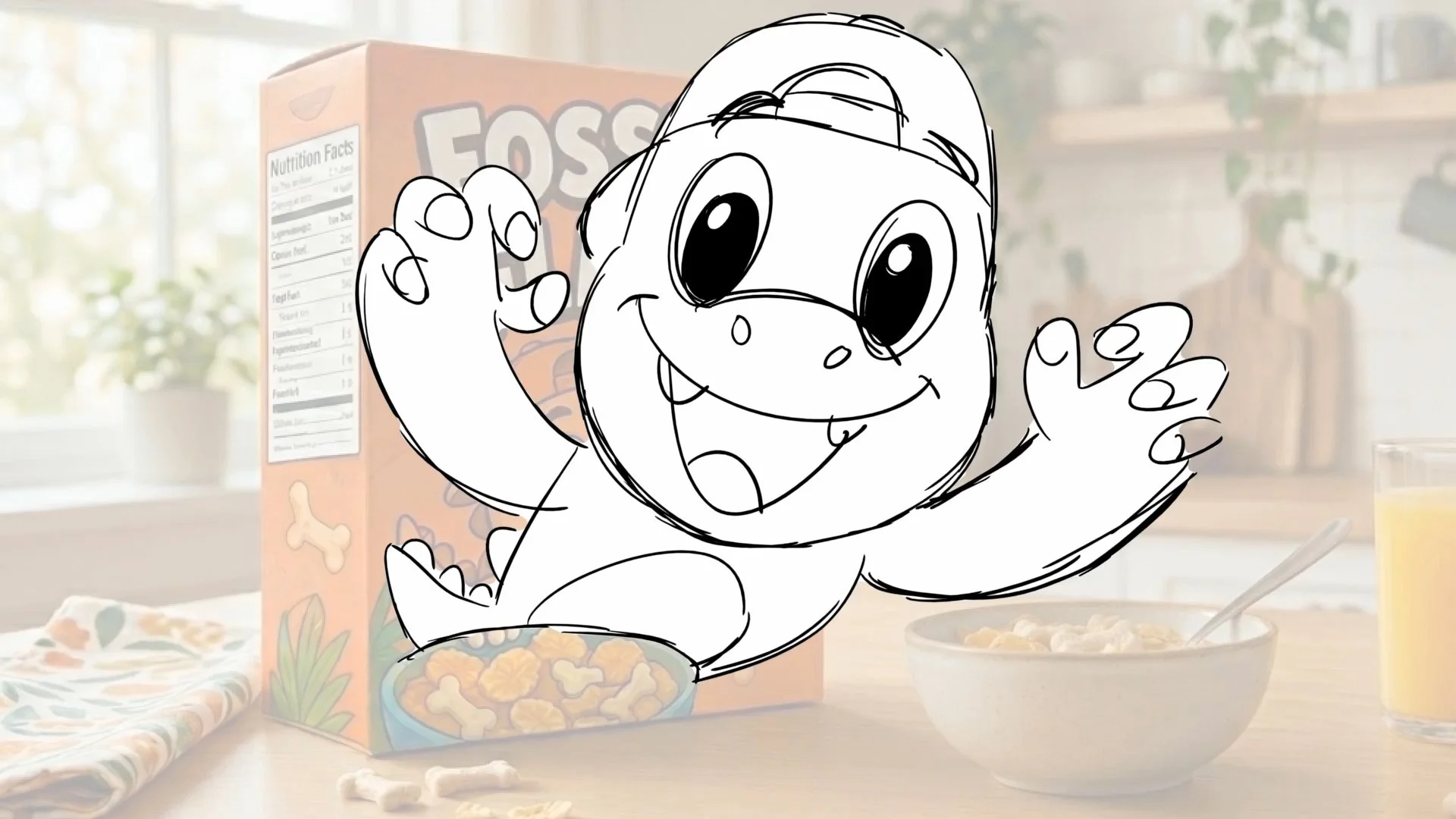
Storyboard frame from ‘Fossil Flakes’
Most of the conversation about AI video right now is about which model is best. We think that’s the wrong question, so we designed a test to show why.
At The AI Summit London this June, we presented a piece of research from the studio. The setup was simple. We invented a cereal brand, Fossil Flakes, and a mascot: Rocky, a baby T-Rex in a backwards orange baseball cap. One brief: produce the final eight seconds of the commercial. The kind of shot a junior team ships every week in a real pipeline.
Then we handed that brief to the top AI video models (Veo, Kling and Seedance among them) and did the thing almost nobody does with AI output: we put it in front of a real animation director and reviewed it like an actual production.
What the review found
A lot of results were bad in the ways you’d expect. But some looked impressive: smooth, styled, confident. The kind of clips that do huge numbers on a timeline. Then the director’s notes came in: hands morphing mid-shot. A tooth that vanishes in one frame and returns two frames later. “The claws are too scary for kids.”
None of those notes is fixable with a better prompt. A review session doesn’t care how the frames were made. It cares whether the character is on model, whether the action reads, and whether a five-year-old will find the mascot friendly. Those are craft judgments, and the models can’t receive them as instructions.
What AI is good at, and where it breaks
The test wasn’t a hit piece, and the results weren’t one-sided. The models were brilliant at some of the most expensive parts of animation: body motion and backgrounds. Weight, follow-through, environmental detail. Work that eats hours in a traditional pipeline came back convincing on the first or second generation.
Where they consistently broke: faces and lip-sync, precisely the things a review lives or dies on. The face is where the audience looks, where the client looks, and where every note lands.
The shot that actually shipped
So we stopped asking the models to do everything. In the final Fossil Flakes shot, the body motion is AI-generated. The face is hand-animated on a ToonBoom rig by animation director Chiara Ferrari, who then retimed both the AI generation and the rig to the animatic. New tools, old craft, one frame.
That division of labor is the point, not a compromise. You put AI where it’s strong (motion, backgrounds, volume) and keep the craft where the model is weak and the stakes are highest (faces, timing, the read). Even inside a single hero character, the face stays on the rig while the body runs on AI.
The takeaway for studios
You don’t win by picking the best model. The gap between the top models shrinks every month, and that race takes care of itself. You win by knowing which older techniques to bring back, and where. The teams getting real production value from AI aren’t the ones with the best prompts. They’re the ones with a director in the loop and a pipeline that routes each task to whatever does it best, model or human.
Sometimes you move forward by looking back.
Animated Company is a London studio bringing AI into animation production: R&D for major studios, finished animation and VFX, and Fossa, our AI toolset for Adobe After Effects. If you’re navigating this from the studio side, get in touch at hello@animatedcompany.com.