
A prompt cannot be revised
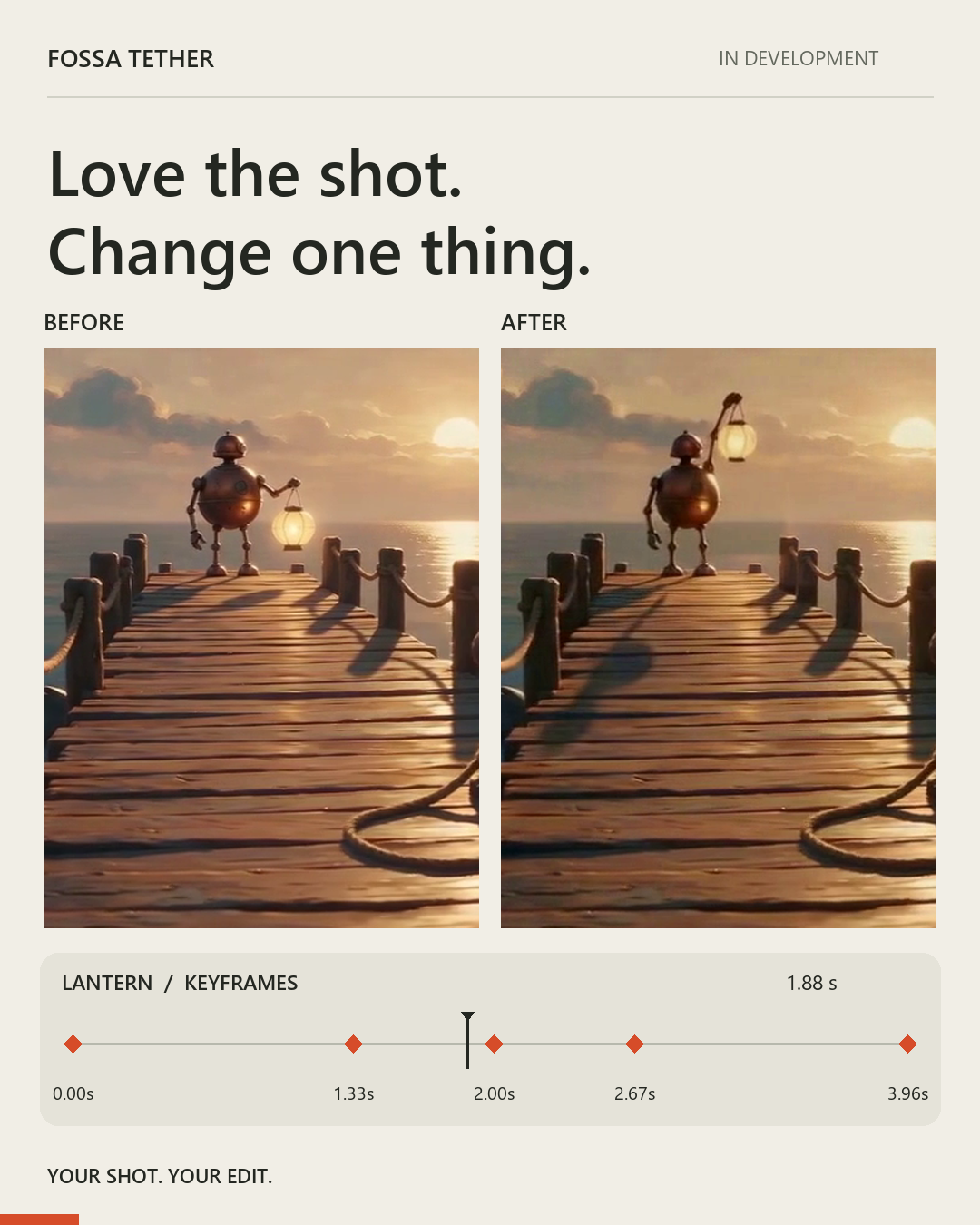
Love the shot. Change one thing. The same generated shot before and after the lantern note, with the keyframes that carried it.
Every animator who has worked with generative video has the same folder. Forty clips, all nearly right. One where the light is perfect and the walk is wrong. One where the walk is perfect and the camera drifts. Nothing in the folder can be fixed, because the only tool for fixing it is to write the paragraph again and roll another take.
That is the part of this technology nobody solved yet, and it has almost nothing to do with model quality.
What a note actually is
In animation, a note is small and specific. Raise the lantern. Hold it a beat longer. Land the step on twelve, not fourteen. The note assumes everything else in the shot stays exactly where it is, because everything else in the shot was already approved. That assumption is the whole basis of how animation gets made. A director gives a note, one thing changes, the rest survives.
A prompt cannot carry a note. You can rewrite it and generate again, but what comes back is not a revision of the shot you liked. It is a different take of a different shot, made by a system with no memory of the one you approved. The light moves. The framing shifts. The walk you wanted is gone. So you describe it harder, and you wait, and you do it again.
There is a name for that in production and it is not iteration. It is gambling with extra steps.
The interface is the problem, not the model
Every few weeks a better video model arrives. Sharper, longer, more coherent. None of it addresses the thing above, because the thing above is a property of the interface rather than the weights. A text box is a bad way to express intent. You cannot describe a performance. You can only perform it.
This is starting to be an industry position rather than ours alone. In August, Autodesk released a 3D editor and canvas for Flow Studio, and titled its own announcement "from generation to direction", describing the work as bringing directable control to generative AI filmmaking. The same month, ByteDance announced Seedance 2.5 with plugins for Maya and Blender, on the reasoning that a video model belongs in the tool an artist already has open rather than in a separate app of its own.
Two different companies, two different approaches, one shared conclusion. The model is no longer the product. What you can change after it runs is the product.
What changing one thing looks like
We spent last week on exactly one question: can a single action inside a generated shot be changed while the rest of the shot holds.
The test was deliberately small. A robot stands at the end of a lamplit dock at sunset. The note was the kind a director gives every day: raise the lantern, hold it, then lower it. Not a new shot. Not a new prompt. One action, changed, inside footage that already worked.
Before and after: the same generated shot, with one action changed by keyframes
The gesture changes. The dock, the water, the light on the planks and the framing all stay where they were. The change was made with keyframes on a timeline, in After Effects, in the way an animator would time any other action, and the shot came back with that timing in it rather than an interpretation of a sentence about it.
Two honest caveats, because the work is not finished. This is a working experiment inside Fossa Tether and not a released feature. The timing and the compositing around the edited region both need more work before anyone should rely on them for a job with a delivery date on it.
Why it matters more than a better model
Feature comparisons between video models are mostly noise for anyone actually delivering animation. They compare the quality of the first take. Nobody in production has ever been limited by the quality of a first take. They are limited by round two, and round nine, and the note that arrives on Friday afternoon about one gesture in one shot that everyone otherwise signed off.
A tool that produces a beautiful first take and cannot take a note is not a production tool. It is a slot machine with good art direction. The work that matters now is the work that makes the second take possible: holding what was approved, changing only what was noted, and doing it inside the timeline where the rest of the edit already lives.
That is what we are building, and it is why we build it inside After Effects rather than in a chat window. Draw where the subject goes. Set the timing. Change one thing and keep the take.
If you have that folder of forty near-misses, we would like to hear which one you would rescue first, and what the note would have been.